Open Now continuous_bulk nude world-class streaming. No strings attached on our media hub. Engage with in a vast collection of films showcased in HD quality, excellent for discerning streaming devotees. With recent uploads, you’ll always have the latest info. Locate continuous_bulk nude specially selected streaming in sharp visuals for a completely immersive journey. Be a member of our video library today to witness unique top-tier videos with free of charge, no commitment. Receive consistent updates and venture into a collection of groundbreaking original content created for exclusive media addicts. Be sure not to miss special videos—start your fast download! See the very best from continuous_bulk nude one-of-a-kind creator videos with crystal-clear detail and members-only picks.
A continuous function is a function where the limit exists everywhere, and the function at those points is defined to be the same as the limit I know that the definition derives from calculus, but why do we define it like that?i mean what kind of property we want to preserve through continuous function? I was looking at the image of a piecewise continuous
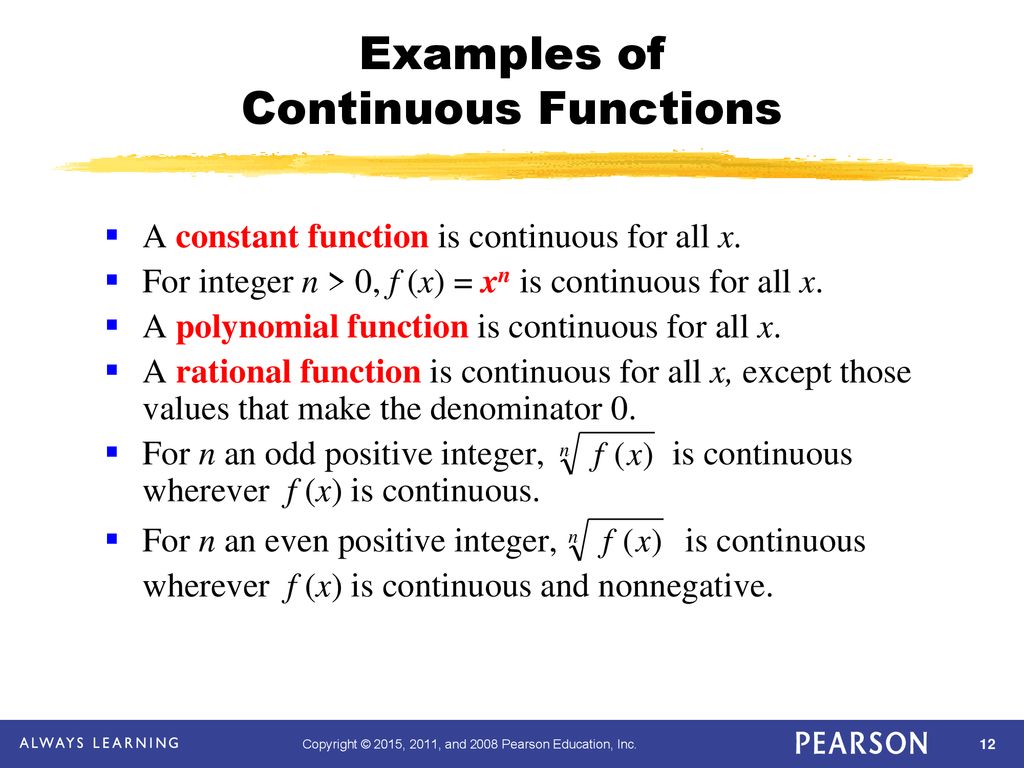
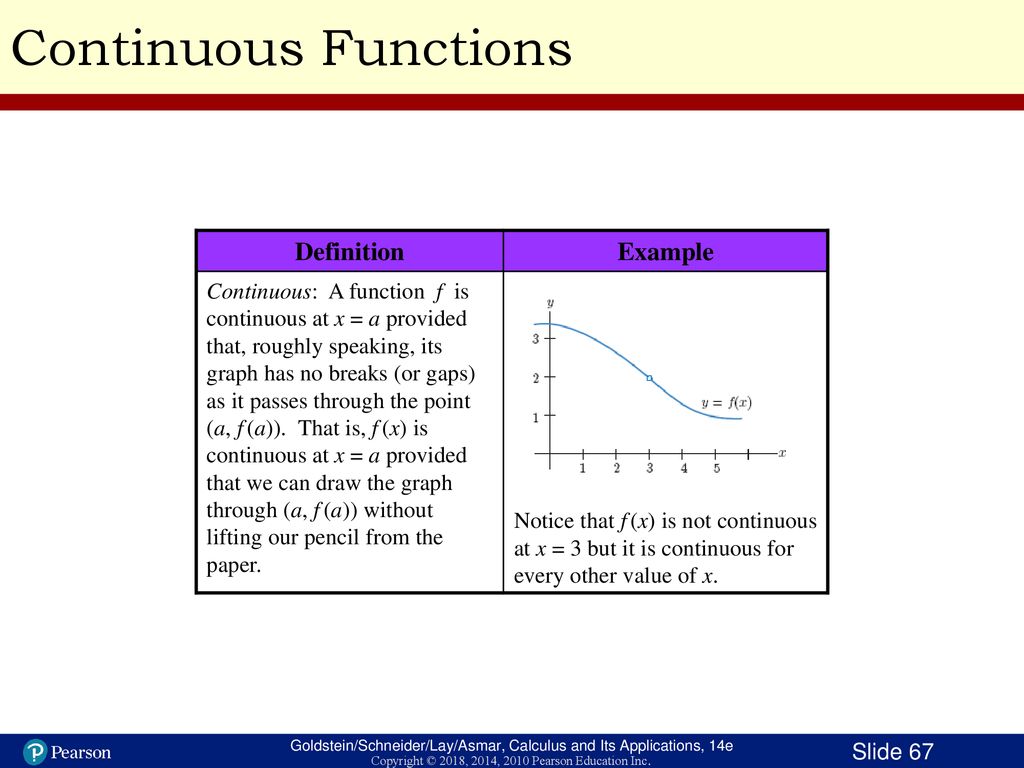
Chapter 2 Limits and the Derivative - ppt download
To understand the difference between continuity and uniform continuity, it is useful to think of a particular example of a function that's continuous on $\mathbb r$ but not uniformly continuous on $\mathbb r$. Continuous from the left/right ask question asked 4 years, 5 months ago modified 4 years, 5 months ago This might probably be classed as a soft question
But i would be very interested to know the motivation behind the definition of an absolutely continuous function
To state a real valued function. Following is the formula to calculate continuous compounding a = p e^(rt) continuous compound interest formula where, p = principal amount (initial investment) r = annual interest rate (as a This is a general question A function is said to be continuous
Can it still have vertical asymptotes Looking at the definition of continuity, i would say no Proving the inverse of a continuous function is also continuous ask question asked 11 years, 11 months ago modified 7 years, 10 months ago 3 this property is unrelated to the completeness of the domain or range, but instead only to the linear nature of the operator

Yes, a linear operator (between normed spaces) is bounded if and only if it is continuous.
Basic real analysis should be a source of at least some intuition (which is misleading at times, granted) Can you think of some compact sets in $\mathbf r$ Are continuous functions on those sets uniformly continuous Can you remember any theorems regarding those
Another idea is to start to try to prove the statement and see whether things start to fall apart.